Pages

Kamis, 10 November 2011

Passive Voice


Passive voice is a sentence which change the subject to be the object and it focus on the action. It does not concern about what or who was doing the action. Sometimes a statement in passive is more polite than active voice.
Example: My bike was stolen.
In this example, I do not know who has stolen my bike.
Example: A mistake was made.
In this case, I focus on the fact that a mistake was made, but I do not blame anyone (e.g. you have made a mistake.).
Form of Passive
Subject + finite form of to be + Past Participle (3rd column of irregular verb)
Example: A letter was written.
When rewriting active sentences in passive voice, note the following:
  • the object of the active sentence becomes the subject of the passive sentence
  • the finite form of the verb is changed (to be + past participle)
  • the subject of the active sentence becomes the object of the passive sentence (or is dropped)
Examples of Passive
Tense
Subject
Verb
Object
Simple Present
Active:
Rita
writes
a letter.
Passive:
A letter
is written
by Rita.
Simple Past
Active:
Rita
wrote
a letter.
Passive:
A letter
was written
by Rita.
Present Perfect
Active:
Rita
has written
a letter.
Passive:
A letter
has been written
by Rita.
Future I
Active:
Rita
will write
a letter.
Passive:
A letter
will be written
by Rita.

Sometimes the passive voice is the best choice. Here are a few instances when the passive voice is quite useful:


1. To emphasize an object.Take a look at this example:
100 votes are required to pass the bill.
This passive sentence emphasizes the number of votes required. An active version of the sentence ("The bill requires 100 votes to pass") would put the emphasis on the bill, which may be less dramatic.

2. To do-emphasize an unknown subject/actor. Consider this example:
Over 120 different contaminants have been dumped into the river.
If you don't know who the actor is—in this case, if you don't actually know who dumped all of those contaminants in the river—then you may need to write in the passive. But remember, if you do know the actor, and if the clarity and meaning of your writing would benefit from indicating him/her/it/them, then use an active construction. Yet consider the third case.

3. If your readers don't need to know who's responsible for the action.
Here's where your choice can be difficult; some instances are less clear than others. Try to put yourself in your reader's position to anticipate how he/she will react to the way you have phrased your thoughts. Here are two examples:
Baby Sophia was delivered at 3:30 a.m. yesterday.(passive)
and
Dr. Susan Jones delivered baby Sophia at 3:30 a.m. yesterday.(active)
The first sentence might be more appropriate in a birth announcement sent to family and friends—they are not likely to know Dr. Jones and are much more interested in the "object"(the baby) than in the actor (the doctor). A hospital report of yesterday's events might be more likely to focus on Dr. Jones' role.

Resources :


Recount Text


Recounts 
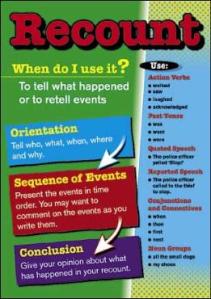
This text is the easiest text rather than other kinds of text because it really closes with your daily life. Have you written diaries or read newspaper report? There are only two kinds of example of recounts text.
 Actually, the purpose of recount text is to retell your experience which happened in the past and this text can entertain and inform your experience to the audience. There is no complication among the participants and that differentiates from narrative

Generic Structure of Recount
1. Orientation: Introducing the participants, place and time
2. Events: Describing series of event that happened in the past
3. Reorientation: It is optional. Stating personal comment of the writer to the story

Language Feature of Recount
• Introducing personal participant; I, my group, etc
• Using chronological connection; then, first, etc
• Using linking verb; was, were, saw, heard, etc
• Using action verb; look, go, change, etc
• Using simple past tense

Example :
My Adventure at Leang Cave
Orientation On Sunday, my parents, my best fruend Novi, and I visited a cave at Maros called Leang-leang . It was my first time to visit the cave, better yet, my best friend came to visit it with me!
Event 1 The cave was famous for its primitive cave wall paintings which were some hand prints and wild boar paintings. The cave and its surroundings was turned into a national park, so it was taken care of. My parents took a rest in a small hut for visitors of the park, while Novi and I adventured around the cave with a guide. We had to climb some metal stairs to get to the cave, because the cave was embedded into a small mountain. Next stop was a place where some seashells littered the ground and some were actually piled into a big mound! The guide said that these piles of seashells are called kjokkenmoddinger, or kitchen trash.
Event 2 The humans who lived here ate the shells and dumped the left overs in their ‘kitchen’. The last place was a small museum where they have skeletons of the humans who lived in the caves. The skeletons along with some roughly made jewelry and weapons were placed inside glass cases for display. The walls of the museum were adorned with photographs taken when they did an excavation there.
Reorientation After a quick lunch with Novi and my parents, we decided it was time to go back home. We really had the time of our lives!
Resources:
http://www.icteachers.co.uk/children/sats/recounts.htm

Discussion Text

Discussion Text
Have you ever heard about discussion text? Did you know the generic structure of discussion text? How about the language features? In this occasion, I will discuss about discussion text more. Now, let me introduce you what discussion text is J
Discussion text is a text which has purpose to present information, arguments, and opinion about more than one side of an issue (from differing point of views). You have to fair both; it means that you are forbidden to choose positive side only or negative side only. You must provide two arguments which are negative and positive side.
In this text, there are 3 generic structures of discussion such as:
1.     Issue
This is your time to introduce what are you going to explain and what the problem which coming up in your writing.
2.    Arguments
a.    Arguments For -> You provide evidence which support and showing your agreement.
b.    Arguments Against -> You provide evidence which showing your disagreement.
3.    Conclusion
Here, you have to conclude and summarize your writing. You have to mention the main idea of positive and negative side. 
Example:


The Controversy of Harnessing Solar Energy

 
Title


We often hear about solar car, solar heating or solar batteries. But will solar energy ever be a major source of energy for industrial societies?


Issue


The solar energy is cheaper than any other fossil fuel because we can get the abundant source from the sun.  In sunny desert areas, 50% of the sun’s radiation that reaches the ground could be used to produce electricity for business and industry, to provide heat, light and hot water for homes. Experimental solar ponds can produce hot water to drive generators.


Arguments For


Unfortunately, we can’t yet power our homes entirely on sunlight. Solar energy can only be exploited in bright light. Its greatest potential therefore is in hot countries that have clear skies for most of the year. While most houses are not always in the sunniest part of the world. In addition, to harness the solar power, solar cells are needed to convert the sunlight directly into electricity. Solar cells are very cheap to run, but relatively expensive to buy and many people can’t afford it.


Arguments Against

 
Needless to say that solar energy is a useful and non-polluted source of energy. Nevertheless, solar cells, the main important device to harness the sun’s energy are still very expensive. 

 
Conclusion
 
Resource:
Sudarwati,. & Grace Eudia. (2005). Look Ahead: An English Course. Jakarta:
Erlangga.
 

(c)2009 LEARNING ENGLISH AT HOME. Based in Wordpress by wpthemesfree Created by Templates for Blogger